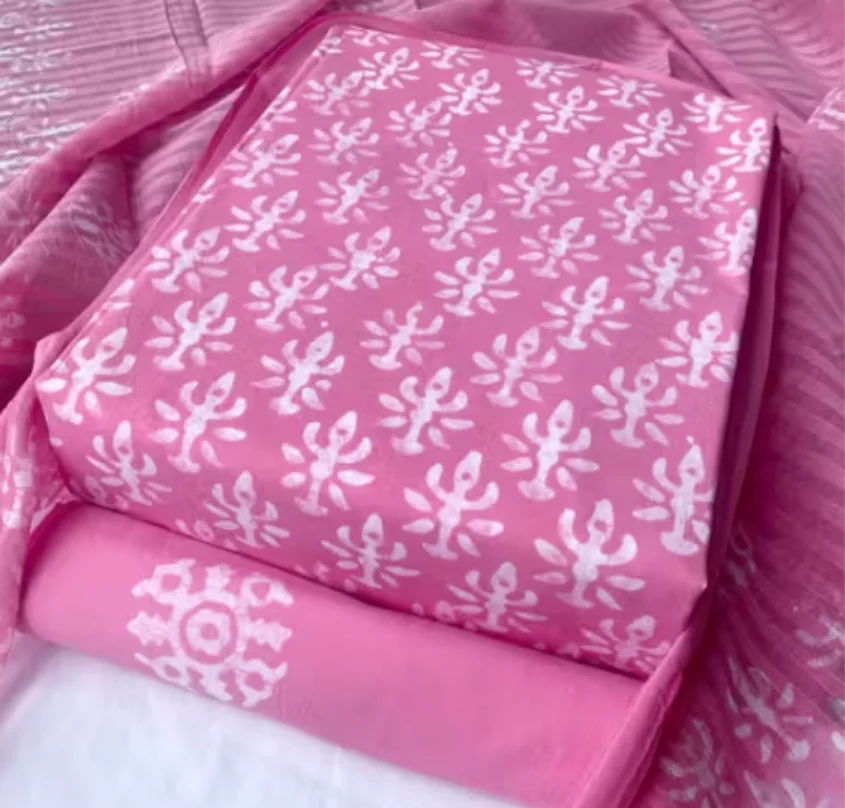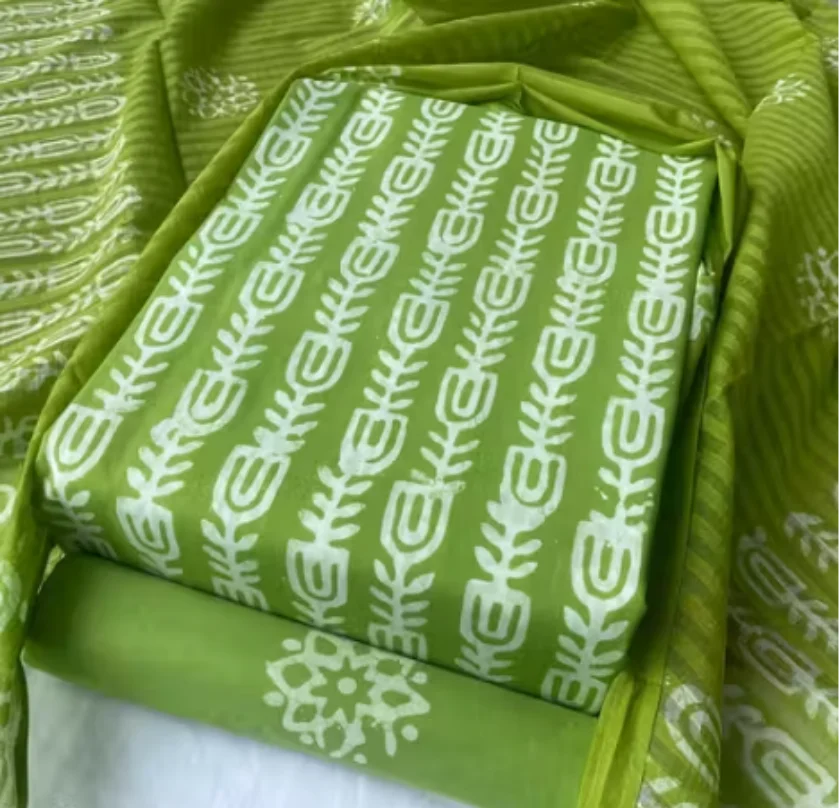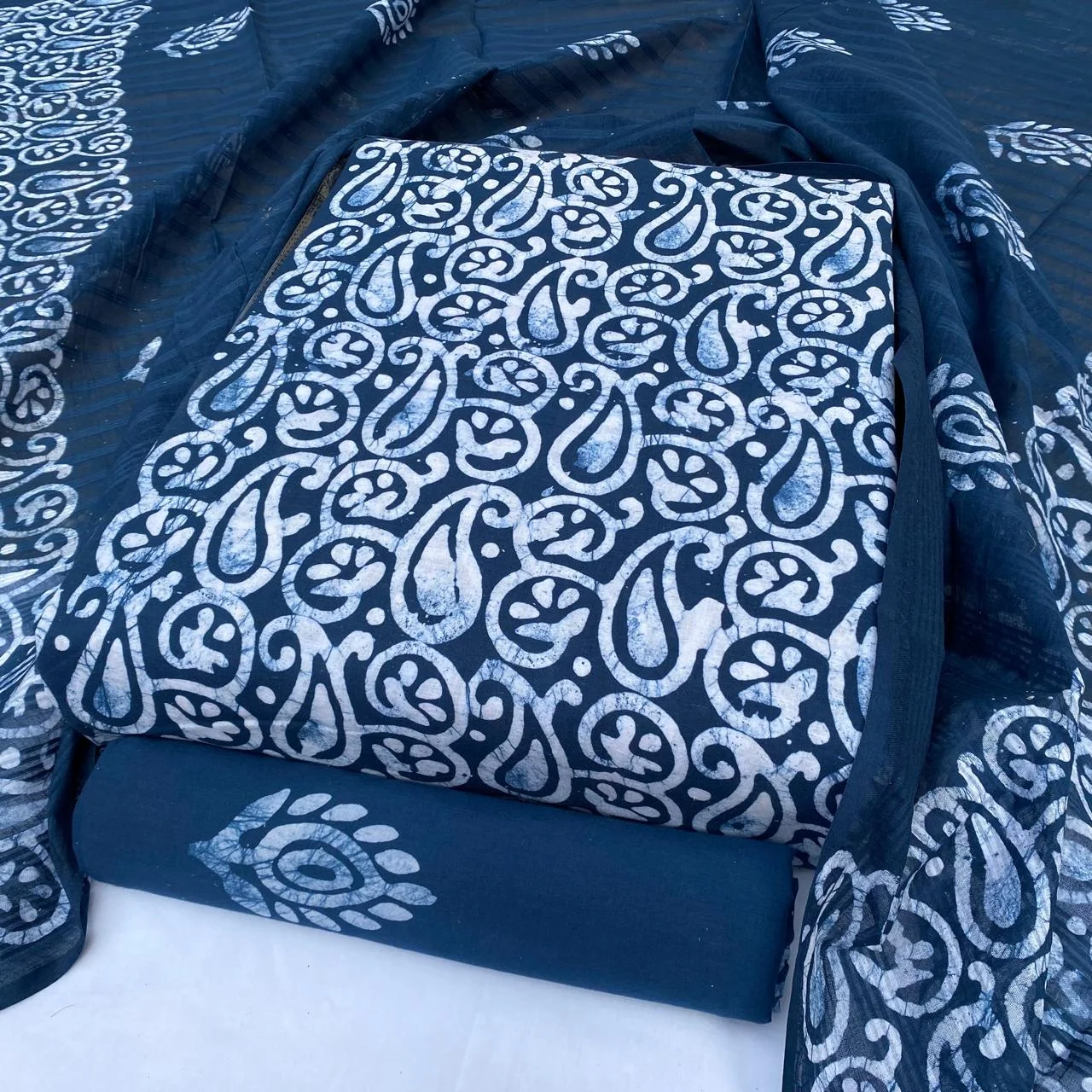
Every few weeks somebody writes to ask whether the thin white lines running across their new dupatta are a printing error. They are not. They are the single clearest proof that the cloth was made by hand.
Batik is a resist process. Wherever molten wax touches the cotton, dye cannot reach the fibre. Lift the wax off later and that area stays the original colour of the cloth. Simple enough — except wax is brittle, and by the time a waxed length is folded into a cold dye vat it has already begun to fracture.
The deliberate fracture
Before the second dip, our printers crush the dried wax in their hands. It is a violent-looking step the first time you see it. The wax splinters into a web of hairline fissures, and in the vat the dye seeps into every one of them.
That is the veining. It cannot be drawn, because no one could draw it convincingly at that scale. It cannot be printed, because a screen would repeat identically every 60 centimetres and the eye catches repetition instantly.
A length with no crackle has usually been screen printed to look like batik.
How to read a length
Hold the cloth to a window. Genuine crackle runs at every angle, denser where the fabric was folded, sparse where it lay flat. It never repeats. If the veining looks even across the whole piece, you are looking at a photograph of batik, not batik.
The other tell is the reverse. Wax penetrates the full thickness of cotton, so a hand-batik length is nearly as strong on the back as the front. A screen print sits on the surface and the reverse is noticeably pale.
2 comments
- KM
Kavita Menon
3 days agoI checked my dupatta against a window after reading this and the veining is completely irregular — such a relief. Thank you for explaining it so clearly.
- AP
Arjun Patel
1 week agoWould love a follow-up on how the wax is recovered after the boil-off. Is any of it reused?
RSRupali Sharma
Rupali Printers6 days agoRoughly 60% is skimmed off the boiling water and reused. The rest goes into the fabric permanently or is lost to the drain trap — we're working on that number.